Python operator library
See Python’s built-in operator library
What we have now
Build test model
import expertsystem as es

result = es.generate_transitions(
    initial_state=[("J/psi(1S)", [-1, 1])],
    final_state=["p", "p~", "eta"],
    allowed_intermediate_particles=["N(1440)"],
    allowed_interaction_types="strong",
)
model = es.generate_amplitudes(result)
for particle in result.get_intermediate_particles():
    model.dynamics.set_breit_wigner(particle.name)
es.io.write(model, "recipe.yml")
Visualize the decay:
import graphviz

graphs = result.collapse_graphs()
dot = es.io.asdot(graphs)
graphviz.Source(dot)
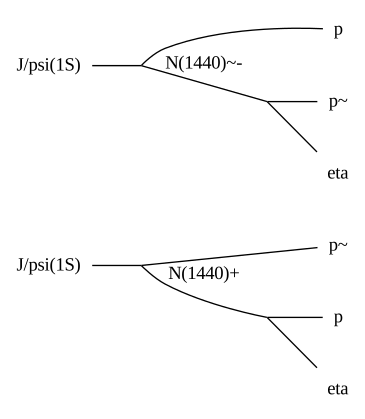
model.parameters
FitParameters([
    FitParameter(name='Magnitude_J/psi(1S)_to_N(1440)+_0.5+p~_-0.5;N(1440)+_to_eta_0+p_0.5;', value=1.0, fix=False),
    FitParameter(name='Magnitude_J/psi(1S)_to_N(1440)+_0.5+p~_0.5;N(1440)+_to_eta_0+p_0.5;', value=1.0, fix=False),
    FitParameter(name='Magnitude_J/psi(1S)_to_N(1440)~-_0.5+p_-0.5;N(1440)~-_to_eta_0+p~_0.5;', value=1.0, fix=False),
    FitParameter(name='Magnitude_J/psi(1S)_to_N(1440)~-_0.5+p_0.5;N(1440)~-_to_eta_0+p~_0.5;', value=1.0, fix=False),
    FitParameter(name='MesonRadius_J/psi(1S)', value=1.0, fix=True),
    FitParameter(name='MesonRadius_N(1440)+', value=1.0, fix=True),
    FitParameter(name='MesonRadius_N(1440)~-', value=1.0, fix=True),
    FitParameter(name='Phase_J/psi(1S)_to_N(1440)+_0.5+p~_-0.5;N(1440)+_to_eta_0+p_0.5;', value=0.0, fix=False),
    FitParameter(name='Phase_J/psi(1S)_to_N(1440)+_0.5+p~_0.5;N(1440)+_to_eta_0+p_0.5;', value=0.0, fix=False),
    FitParameter(name='Phase_J/psi(1S)_to_N(1440)~-_0.5+p_-0.5;N(1440)~-_to_eta_0+p~_0.5;', value=0.0, fix=False),
    FitParameter(name='Phase_J/psi(1S)_to_N(1440)~-_0.5+p_0.5;N(1440)~-_to_eta_0+p~_0.5;', value=0.0, fix=False),
    FitParameter(name='Position_N(1440)+', value=1.44, fix=False),
    FitParameter(name='Position_N(1440)~-', value=1.44, fix=False),
    FitParameter(name='Width_N(1440)+', value=0.35, fix=False),
    FitParameter(name='Width_N(1440)~-', value=0.35, fix=False),
])
Implementation with operators
See this answer on Stack Overflow:
import operator

MAKE_BINARY = lambda opfn: lambda self, other: BinaryOp(  # noqa: E731
    self, asMagicNumber(other), opfn
)
MAKE_RBINARY = lambda opfn: lambda self, other: BinaryOp(  # noqa: E731
    asMagicNumber(other), self, opfn
)


class MagicNumber(object):
    __add__ = MAKE_BINARY(operator.add)
    __sub__ = MAKE_BINARY(operator.sub)
    __mul__ = MAKE_BINARY(operator.mul)
    __radd__ = MAKE_RBINARY(operator.add)
    __rsub__ = MAKE_RBINARY(operator.sub)
    __rmul__ = MAKE_RBINARY(operator.mul)
    # __div__  = MAKE_BINARY(operator.div)
    # __rdiv__ = MAKE_RBINARY(operator.div)
    __truediv__ = MAKE_BINARY(operator.truediv)
    __rtruediv__ = MAKE_RBINARY(operator.truediv)
    __floordiv__ = MAKE_BINARY(operator.floordiv)
    __rfloordiv__ = MAKE_RBINARY(operator.floordiv)

    def __neg__(self, other):
        return UnaryOp(self, lambda x: -x)

    @property
    def value(self):
        return self.eval()


class Constant(MagicNumber):
    def __init__(self, value):
        self.value_ = value

    def eval(self):
        return self.value_


class Parameter(Constant):
    def __init__(self):
        super(Parameter, self).__init__(0.0)

    def setValue(self, v):
        self.value_ = v

    value = property(fset=setValue, fget=lambda self: self.value_)


class BinaryOp(MagicNumber):
    def __init__(self, op1, op2, operation):
        self.op1 = op1
        self.op2 = op2
        self.opn = operation

    def eval(self):
        return self.opn(self.op1.eval(), self.op2.eval())


class UnaryOp(MagicNumber):
    def __init__(self, op1, operation):
        self.op1 = op1
        self.operation = operation

    def eval(self):
        return self.opn(self.op1.eval())


asMagicNumber = (
    lambda x: x if isinstance(x, MagicNumber) else Constant(x)  # noqa: E731
)
asMagicNumber(2).eval()
2
Other ideas
Option 1: parameter container
Remove name from the FitParameter class and give the FitParameters collection class the responsibility to keep track of ‘names’ of the FitParameters as keys in a dict. In the AmplitudeModel, locations where a FitParameter should be inserted are indicated by an immutable (!) str that should exist as a key in the FitParameters.
Such a setup best reflects the structure of the AmplitudeModel that we have now (best illustrated by expected_recipe, note in particular YAML anchors like &par1/*par1). It also allows one to couple FitParameters. See following snippet:
import attr


# the new FitParameter class would have this structure
@attr.s
class Parameter:
    value: float = attr.ib()
    fix: bool = attr.ib(default=False)


# the new FitParameters collection would have such a structure
mapping = {
    "par1": Parameter(1.0),
    "par2": Parameter(2.0, fix=False),
}


# intensity nodes and dynamics classes contain immutable strings
class Dynamics:
    pass


@attr.s
class CustomDynamics(Dynamics):
    par: str = attr.ib(on_setattr=attr.setters.frozen, kw_only=True)


dyn1 = CustomDynamics(par="par1")
dyn2 = CustomDynamics(par="par2")

# Parameters would be coupled like this
mapping["par1"] = mapping["par2"]
assert mapping["par2"] is mapping["par1"]
assert mapping["par1"] == {
    "par1": Parameter(1.0),
    "par2": Parameter(1.0),
}
Option 2: read-only parameter manager
Remove the FitParameters collection class altogether and use something like immutable InitialParameter instances in the dynamics and intensity section of the AmplitudeModel. The AmplitudeModel then starts to serve as a read-only’ template. A fitter package like tensorwaves can then loop over the AmplitudeModel structure to extract the InitialParameter instances and convert them to something like an FitParameter.
Here’s a rough sketch with tensorwaves in mind.
from typing import Dict, Generator, List

import attr

from expertsystem.amplitude.model import (
    AmplitudeModel,
    Dynamics,
    Node,
    ParticleDynamics,
)
from expertsystem.reaction.particle import Particle


@attr.s
class InitialParameter:
    name: str = attr.ib()
    value: float = attr.ib()
    # fix: bool = attr.ib(default=False)


@attr.s
class FitParameter:
    name: str = attr.ib(on_setattr=attr.setters.frozen)
    value: float = attr.ib()
    fix: bool = attr.ib(default=False)


class FitParameterManager:
    """Manages all fit parameters of the model"""

    def __init__(self, model: AmplitudeModel) -> None:
        self.__model: AmplitudeModel
        self.__parameter_couplings: Dict[str, str]

    @property
    def parameters(self) -> List[FitParameter]:
        initial_parameters = list(__yield_parameter(self.__model))
        self.__apply_couplings()
        return self.__convert(initial_parameters)

    def couple_parameters(self, parameter1: str, parameter2: str) -> None:
        pass

    def __convert(self, params: List[InitialParameter]) -> List[FitParameter]:
        pass


@attr.s
class CustomDynamics(Dynamics):
    parameter: InitialParameter = attr.ib(kw_only=True)

    @staticmethod
    def from_particle(particle: Particle):
        pass


def __yield_parameter(
    instance: object,
) -> Generator[InitialParameter, None, None]:
    if isinstance(instance, InitialParameter):
        yield instance
    elif isinstance(instance, (ParticleDynamics, Node)):
        for item in instance.values():
            yield from __yield_parameter(item)
    elif isinstance(instance, (list,)):
        for item in instance:
            yield from __yield_parameter(item)
    elif attr.has(instance.__class__):
        for field in attr.fields(instance.__class__):
            field_value = getattr(instance, field.name)
            yield from __yield_parameter(field_value)


# usage in tensorwaves
amp_model = AmplitudeModel()
kinematics: HelicityKinematics = ...
builder = IntensityBuilder(kinematics)

intensity = builder.create(amp_model)  # this would call amp_model.parameters
parameters: Dict[str, float] = intensity.parameters
# PROBLEM?: fix status is lost at this point

data_sample = generate_data(...)
dataset = kinematics.convert(data_sample)

parameters["Width_f(0)(980)"] = 0.2  # name is immutable at this point

# name of a parameter can be changed in the AmplitudeModel though
# and then call builder again
intensity(dataset, parameters)